
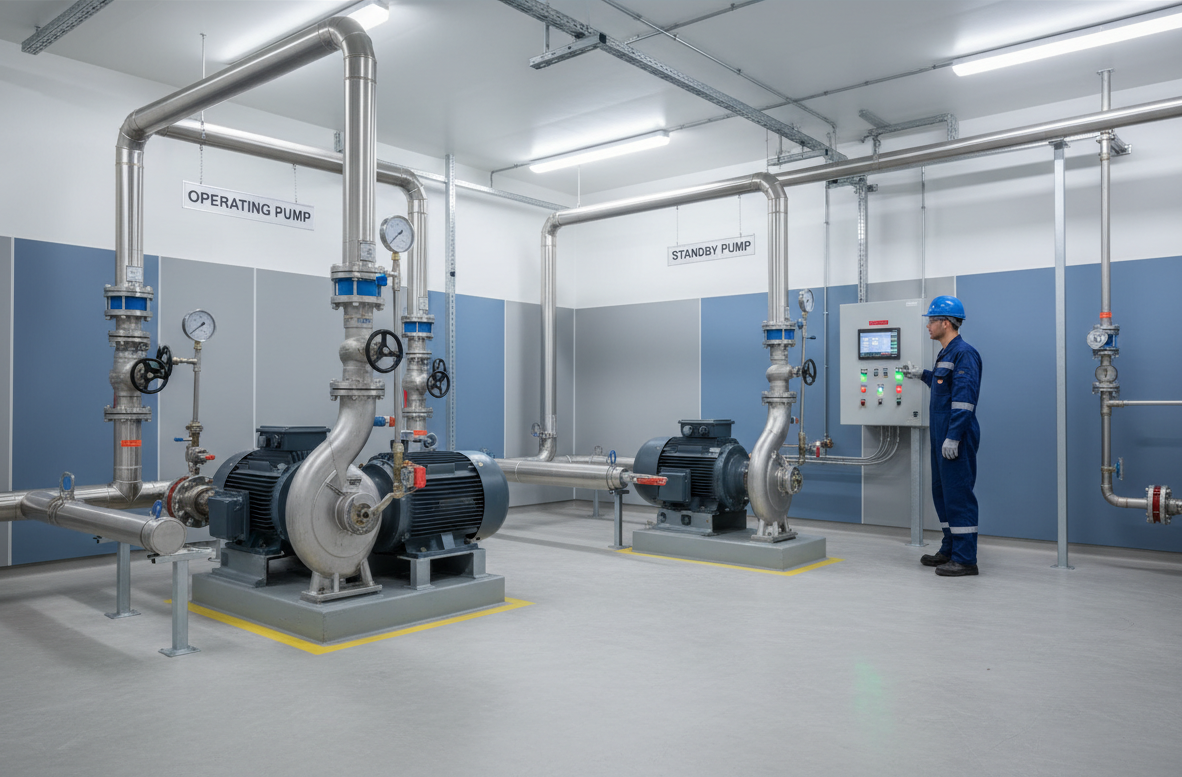
Why Standby Pumps Fail When You Finally Need Them
A standby pump can create a powerful sense of security. It is installed, connected, and ready to take over if the duty pump fails. On paper, the system has redundancy. In practice, that backup may have been sitting untouched for months, quietly developing problems no one will discover until the exact moment it is needed.
A reliable standby pump is part of an operating strategy, and it needs to be exercised, monitored, maintained, and proven under realistic conditions. Without that discipline, redundancy becomes little more than a comforting line on a design drawing.
Idle Equipment Still Ages
Standby pumps may accumulate fewer operating hours, but they do not stop aging. Seals can dry out. Bearings can lose lubrication. Corrosion can develop. Electrical contacts can degrade. Check valves can stick, and isolation valves can become difficult to operate. The pump may look untouched and therefore healthy. In reality, long periods of inactivity can create their own failure modes.
This is one reason a low-drama, predictable environment matters so much. In a previous article, The case for boring pump rooms, we made the case that the most reliable pump rooms are usually the least dramatic. Standby equipment should support that stability, not create a hidden source of uncertainty.
Automatic Changeover Needs To Be Proven
Many systems are designed to transfer automatically from the duty pump to a standby unit. That sounds reassuring, but automatic logic is only useful if it has been tested.
A failed pressure transducer, outdated controller setting, tripped disconnect, or closed valve can prevent changeover even when the standby pump itself is mechanically sound. Sometimes the system will start the backup but fail to isolate the original unit properly. In other cases, both pumps run and begin fighting the same control point.
The only way to know whether automatic changeover works is to test it under controlled conditions. Simulate the failure. Confirm the standby pump starts. Verify that it reaches the required pressure or flow. Check that alarms reach the correct person. Then document what happened.
This should be part of commissioning and routine maintenance, not something discovered during an emergency.
Regular Rotation is Better Than Occasional Testing
A standby pump should not spend its entire life waiting.
Rotating duty between pumps helps equalize wear and proves that each unit can carry the process. Depending on the application, rotation may occur weekly, monthly, or after a defined number of operating hours. The right schedule matters less than having a schedule that is followed.
Regular rotation also gives operators a chance to notice small differences. Does one pump take longer to reach pressure? Does one run at a higher speed to deliver the same result? Does one make more noise during startup? These are early warnings that would remain hidden if the standby unit were left untouched. (Relevant reading: Why set and forget is the most expensive strategy in fluid handling) Standby systems drift, even when they are not running. Settings change, process demands evolve, and equipment ages.
Good Design Makes Standby Testing Easier
The physical design of the pump room also affects whether standby equipment gets tested properly. Operators need clear isolation valves, readable gauges, safe access, and controls that make duty rotation straightforward.
If testing the standby pump requires an awkward manual sequence, a shutdown, or someone who remembers an undocumented procedure, it will not happen often enough. Good design removes those barriers.
Our article, What does good system design look like in a pump room?, explores how access, visibility, valve placement, and serviceability shape reliability long after installation.
A Simple Standby Readiness Routine
A practical routine should include:
- Rotate duty pumps on a defined schedule.
- Verify suction and discharge valves are in their correct positions.
- Confirm the standby pump reaches its required flow and pressure.
- Test automatic changeover and alarm delivery.
- Compare vibration, temperature, speed, and pressure against the duty pump.
- Inspect seals, check valves, couplings, and electrical connections.
- Record the results and assign corrective work immediately.
Any temporary bypasses or control overrides used during testing should also be removed and documented. As discussed in The real cost of temporary fixes in industrial pump systems, short-term workarounds become long-term risks when no one comes back to close the loop.
For help reviewing redundancy, controls, or the condition of an existing industrial pump system, explore Vissers Sales Corp.’s industrial pump systems or contact our team using Canada toll-free at 1-800-367-4180 to get a conversation started