
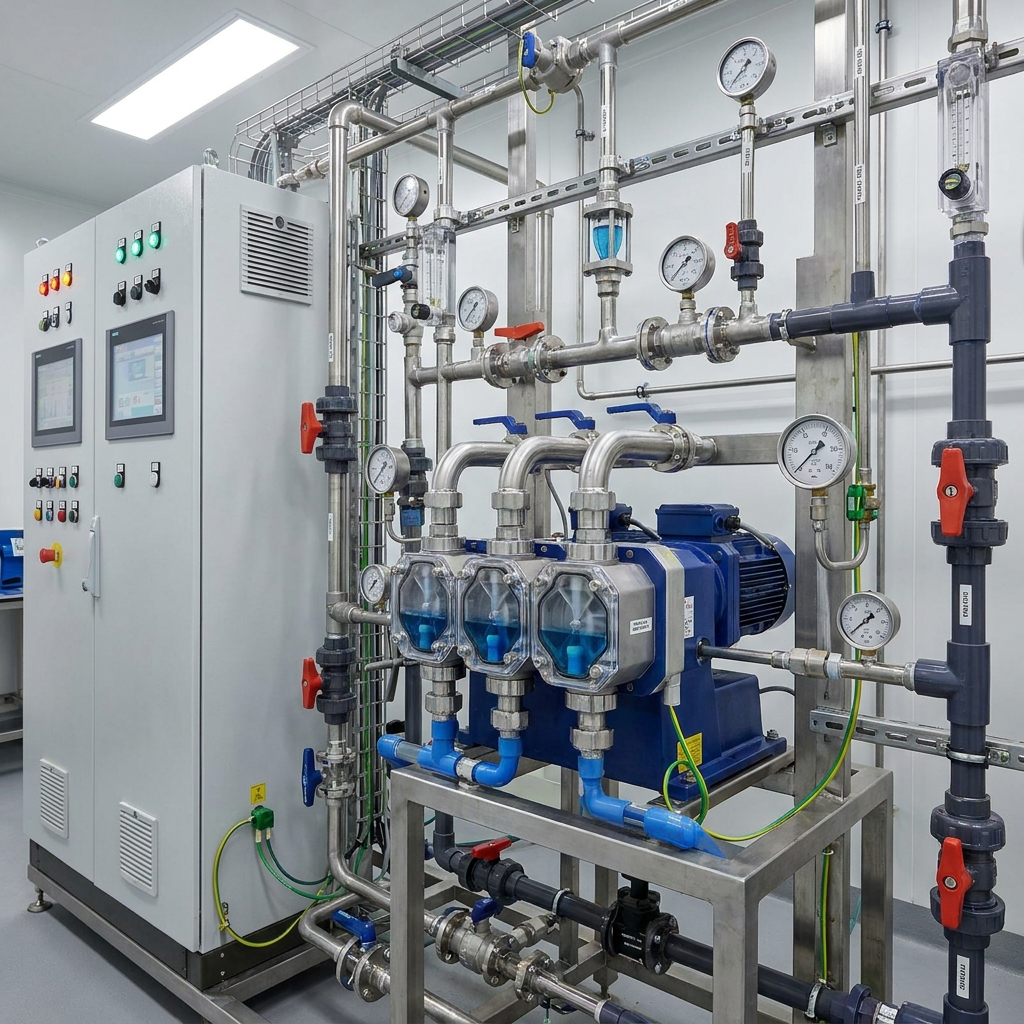
Why Set and Forget is the Most Expensive Strategy in Fluid Handling
Sometimes, pump systems can be forgotten and in the background because they’re not giving you any major trouble. This creates the impression that everything is fine because nothing has failed dramatically. Pressure is close enough. The pump still starts. The dosing skid still injects. The mixer still turns. So the system gets left alone. No one revisits the setpoints. No one checks whether the calibration still holds. No one asks whether the process has changed enough to make the original settings outdated.
That is where cost starts to creep in.
In fluid handling, “set it and forget it” sounds efficient. In practice, it is often one of the most expensive ways to operate. Because systems drift slowly while still appearing functional. By the time the problem becomes obvious, the plant has usually been paying for it for months.
Systems Do Not Stay Still Just Because the Settings Do
Pump systems are dynamic. Processes change. Strainers load up. Valves wear. Accessories age. Product demand shifts. Chemical properties move with temperature. Tank levels vary. Operators make small adjustments. Maintenance replaces a component with a similar-but-not-identical part. None of these changes seems large on its own, but together they move the system away from the condition it was originally tuned for.
The settings, meanwhile, often stay exactly where they were.
That mismatch is expensive. A booster system may now be holding a higher pressure than the process really needs. A metering pump may still be set to the same stroke and speed even though the chemical strength or dilution conditions have changed. A VFD may still be tuned for a system layout that no longer matches reality. The equipment is “working,” but the process is no longer optimized.
One of the reasons this strategy is so expensive is that it rarely creates one dramatic cost. It creates many quiet ones.
A slightly high setpoint increases energy use every hour. A dosing pump that is 8% off target wastes chemical every day. A clogged strainer that no one logs pushes the pump to work harder than necessary. A pressure transducer that is drifting slowly makes the control loop less stable, which increases wear and operator frustration.
Each of these issues feels survivable. Together, they create a system that costs more to run, delivers less confidence, and requires more intervention than people realize.
That makes What to log in your pump room and why it saves real money an important companion piece to this article, because the first defence against drift is usually a simple record of what “normal” looks like.
Calibration is Not a One-Time Event
This is especially true in dosing systems. Many facilities calibrate a metering pump at startup, then assume the number holds indefinitely. But real dosing depends on more than the pump setting. Temperature changes, degassing, check valve wear, suction conditions, and injection behaviour all affect delivered volume and process result. A pump can still be mechanically sound while its real-world performance drifts enough to matter.
That is why calibration should be treated as part of routine operation, not a commissioning task that lives in the past. Verifying output with a calibration column and stopwatch is simple, fast, and much cheaper than guessing.
“It still runs” is not the same as “it still runs well.”
That distinction matters.
Plants often adapt to weak performance without realizing they are adapting. Operators compensate manually. Maintenance gets used to frequent small interventions. Alarm thresholds get mentally reclassified as background noise. Workarounds become normal. In that kind of environment, no one is really forgetting the system. They are constantly compensating for the fact that it has drifted. They just are not calling it by that name.
This is one reason small maintenance habits matter so much. They interrupt drift before it turns into a culture of compensation.
The Cheapest Review is the One You Do Before the Problem Grows
A good review does not need to be complex. It can be as simple as asking a few questions once a month or once a quarter:
- Are our setpoints still aligned with actual process needs?
- Are our suction and discharge numbers still where they should be?
- Are accessories like back-pressure valves, dampeners, and relief valves still doing their job?
- Is the dose we think we are delivering actually the dose we are delivering?
- Have operators started compensating for anything manually?
Those questions cost almost nothing. Ignoring them is what gets expensive.
The idea that a system can be set once and left alone indefinitely is comforting, but it is rarely true in the real world. Drift is normal. Change is normal. Process conditions move. Equipment ages.
We at Vissers Sales Corp specialize in optimizing pump systems to ensure maximum reliability and minimum operating cost. Reach out to us in Canada toll-free on 1-800-367-4180 to get a conversation started.