
Why Chemical Feed Systems Fail At The Edges, Not In The Middle
Most chemical feed systems fail at the edges.
Not during the middle of a steady run, when the tank level is normal, the suction is clean, the dilution water is consistent, and the injection point is behaving. They fail during startup. During shutdown. When the tank gets low. When the chemical warms up. When the dilution changes. When air sneaks into the suction line. When the process flow shifts and the injection point suddenly stops doing what everyone assumed it was doing.
That is why so many dosing problems feel inconsistent and hard to pin down. The system may work perfectly well under one set of conditions and then behave unpredictably the moment those conditions start changing. The pump gets blamed because it is the visible piece of equipment. But most of the time, the real issue lives in the transition.
This is one of the most useful ways to think about chemical feed systems. If you want to understand where they are most vulnerable, do not just study how they behave in the middle. Study what happens at the edges.
Startup is one of the clearest examples. A system that doses beautifully once it is fully primed and pressurized may be unreliable for the first few minutes of operation. Air may still be leaving the head. The suction line may not yet be fully wet. The back-pressure condition may not be stable. If the operator assumes the pump should be accurate from the very first stroke, it is easy to mistake a startup condition for a pump problem. Many dosing issues begin with small setup decisions that only reveal themselves during startup. The cleaner the setup, the fewer surprises you get when the system first begins moving chemical.
Shutdown creates its own risks. A system may lose prime, allow air ingress, or leave chemical sitting in a place where crystallization, gas release, or material attack can begin before the next run. Some of the most frustrating intermittent problems come from a system that looks fine while running but restarts poorly because shutdown conditions quietly set up the next failure.
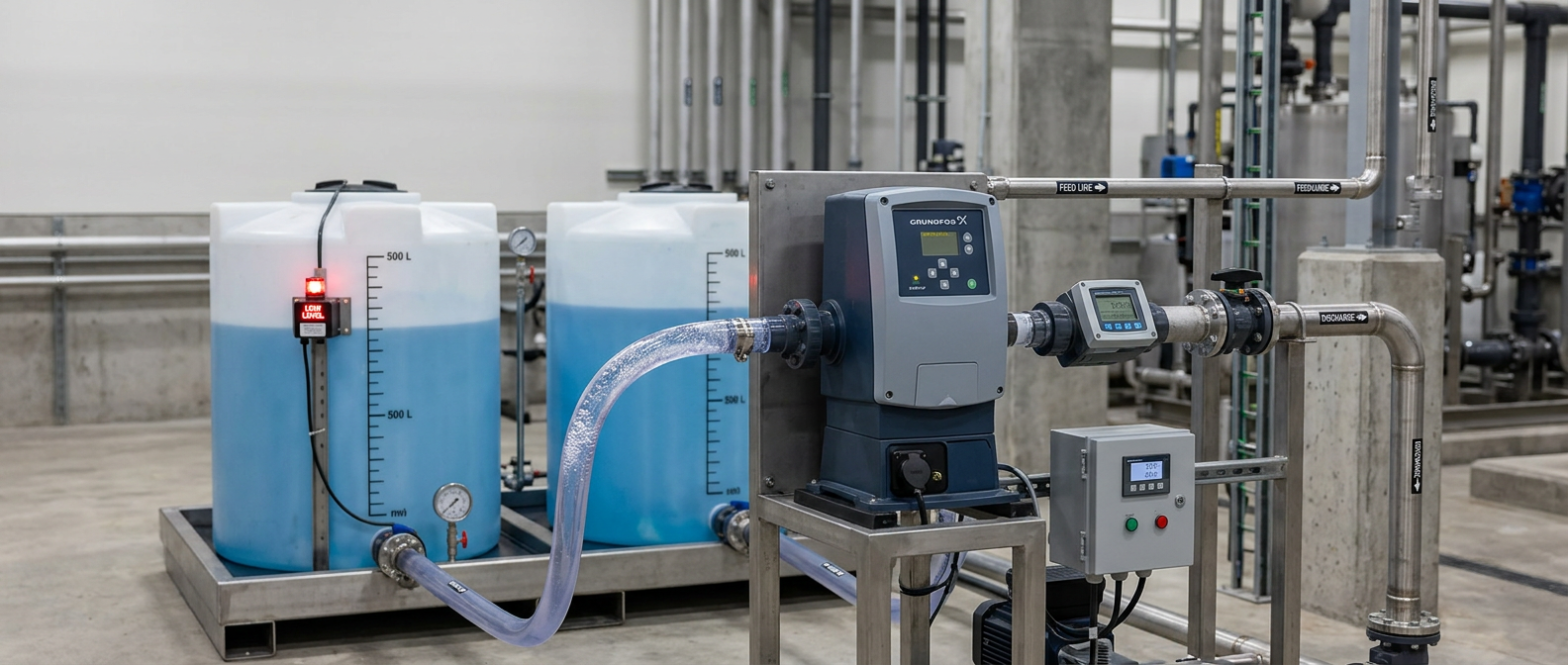
Low tank level is another edge condition that causes trouble far more often than teams expect. As level drops, suction characteristics can change. Foot valves may begin pulling small amounts of air. Settled solids or debris may become more likely to enter the line. In hypochlorite systems, gas release becomes more noticeable as conditions change, and what looked like a stable metering pump can suddenly begin losing output because it is pulling a frothy, inconsistent feed.
Dilution changes are another hidden source of failure at the edges. A dosing system may be set perfectly, but if dilution water pressure or flow varies, the effective chemical concentration at the injection point changes with it. The metering pump may still be delivering exactly what it should, while the process result tells a different story. In practice, this is one reason operators can end up chasing the pump setting when the actual problem lives in a separate utility line.
Air in the suction is perhaps the most common edge failure of all. Metering pumps are very good at moving liquid. They are much less impressive when asked to move gas bubbles. Once air enters the suction line, delivered output becomes inconsistent, prime becomes fragile, and confidence in the whole system drops. It is not enough to say the pump is sized correctly if the suction conditions allow gas or air to enter whenever the system shifts away from its ideal state.
The broader lesson is that chemical feed systems should not be judged only when conditions are ideal. They should be tested, reviewed, and understood where they are most likely to struggle: at startup, at shutdown, at low level, during changeovers, and under shifting process demand. Those edge conditions are where reliability is either proven or exposed.
If you are ready to stop compensating for intermittent dosing issues and want a system that stays reliable through startup, shutdown, and every change in between, let’s talk. We at Vissers Sales Corp specialize in diagnosing the edge conditions that cause the majority of dosing failures. Reach out to us in Canada toll-free at 1-800-367-4180 to get a conversation started.