How a Booster Pump and Water System Solve Low Pressure and Flow for Industrial Users
Introduction to Water Pressure Booster Pump Technology
Pressure deficits in industrial water systems rarely announce themselves gradually. They surface as erratic process-line behaviour, equipment cycling at incorrect rates, and accelerated wear on downstream components. A water pressure booster pump adds mechanical energy when the supply pressure falls below the required operating pressure.
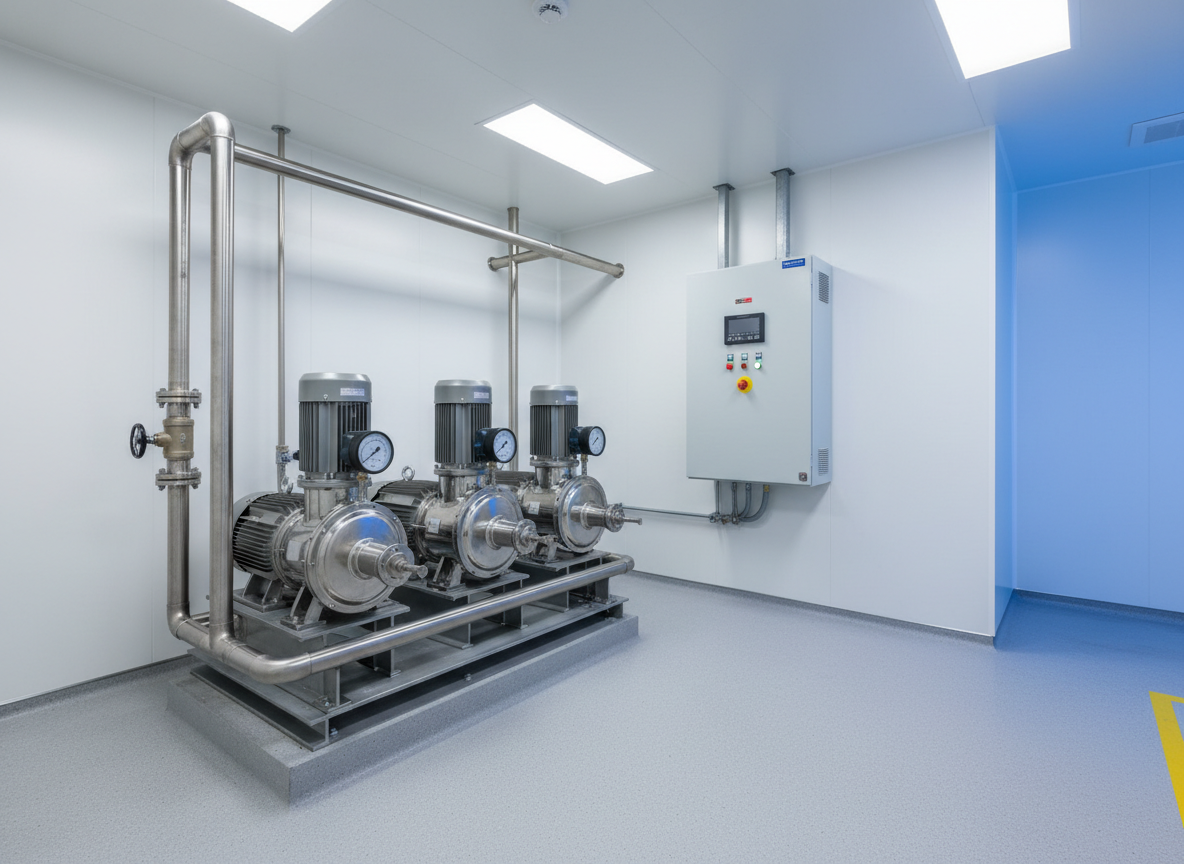
Two primary system configurations serve most industrial and commercial facilities. Potable water booster pumps prioritize hygiene and material safety, meeting certification requirements for drinking water, healthcare, and food-grade environments. Constant pressure booster systems use variable-speed technology to continuously modulate output in response to fluctuating demand, making them well-suited to manufacturing environments and multi-storey facilities where draw patterns shift throughout the day.
Selecting the wrong configuration compounds the original problem. A mismatched system underperforms from commissioning onward, leading to unplanned maintenance and shortening its service life.
People Also Ask
What factors are most important when sizing an industrial water pressure booster pump?
Key sizing factors include the required flow rate, total pressure demand, elevation (static head), friction losses in piping, and real operating conditions. Proper sizing typically requires calculating the total dynamic head and accounting for demand variation to ensure the system maintains stable pressure under changing loads.
What happens if an industrial water booster pump is oversized or undersized?
An undersized booster pump can cause pressure drops and unstable operation during peak demand. An oversized pump can lead to excessive cycling, higher energy use, and increased mechanical wear, which reduces efficiency and reliability over time.
Identifying Causes of Low Water Pressure and Flow
Gravity is a persistent adversary in multi-storey industrial and commercial buildings. As elevation increases, available pressure at upper floors drops materially, and without mechanical compensation, equipment on higher levels operates below its required threshold. This is one of the most consistently reported causes of inadequate pressure in tall facilities.
Municipal supply pressure introduces a separate vulnerability. During peak-demand periods, delivery rates from the municipal network drop noticeably, and facilities drawing on shared infrastructure absorb the resulting deficit directly. Backflow preventers, aging distribution mains, and population-driven demand growth all compound this effect over time.
Friction losses in extensive piping networks further reduce the available flow before it reaches end-use equipment. Long pipe runs, numerous fittings, and elevation changes each subtract from the pressure available at the point of use. Facilities with large footprints or complex distribution layouts are especially exposed to this cumulative loss, and a pressure booster pump is the most direct corrective measure.
How a Water Pressure Booster Pump Optimizes Industrial Systems
Variable speed drives support pressure regulation in modern booster systems. Rather than cycling on and off at fixed setpoints, a variable speed drive modulates pump output in real time to match actual system demand. This eliminates pressure spikes, reduces mechanical stress on seals and impellers, and meaningfully delivers more stable pressure across every outlet in the distribution network.
Integrated controllers extend this stability further. When multiple machines or process lines operate simultaneously, the controller maintains target pressure without manual intervention, protecting sensitive downstream equipment from the pressure fluctuations that accelerate wear.
Material selection is a critical factor in industrial service. Stainless steel wetted components resist corrosion and meet hygiene requirements for potable and food-grade applications. Cast iron configurations suit general industrial water distribution where corrosion exposure is lower and cost efficiency is a priority. Specifying materials without verifying compatibility against actual service conditions is a consistently cited cause of premature pump failure across industrial installations.
Also Read:
How to Know If a Water Pressure Booster Pump Needs Repair or Replacement
How to Calculate the Right Water Pressure Booster Pump Size for Industrial Facilities
What Engineers Need to Know About Sizing an Industrial Water Pressure Booster Pump
Implementing a Water Pressure Booster Pump Canada Solution
Correct pump selection begins with evaluating dynamic head and peak flow requirements together. Undersizing results in chronic underperformance; oversizing leads to unnecessary energy consumption and accelerates wear on rotating components. Both outcomes increase total lifecycle cost and reduce system reliability.
Professional installation is equally important. Provincial plumbing codes govern booster pump installations across Canada, and compliance requires that equipment selection, piping configuration, and control integration all meet applicable standards. For potable water service, NSF/ANSI certification for wetted materials is a non-negotiable requirement, not an optional specification upgrade.
Facility managers and procurement teams evaluating a water pressure booster pump in Canada can contact Vissers Sales Corp. directly. Vissers Sales Corp. provides tailored equipment recommendations based on actual system parameters, ensuring the selected configuration delivers reliable, long-term performance across the full range of industrial and commercial service conditions.