What Does Good System Design Look Like in a Pump Room?
Good pump rooms do not happen by accident. They are rarely the result of one premium component or one clever design detail. More often, they reflect a set of thoughtful decisions made early, before the first startup, when it is still easy to prevent future problems instead of reacting to them. When a pump room is well designed, operators notice. Maintenance notices. Safety teams notice. Even energy costs tend to be noticed.
The opposite is also true. Poor pump room design creates friction that never really goes away. Gauges end up where no one can read them. Valves are too tight to reach safely. Containment is an afterthought. Relief discharge goes somewhere inconvenient. Labels are missing. A technician needs three extra steps and an awkward posture to do a simple task. Over time, those small annoyances turn into workarounds, then permanent inefficiency.
That is why good system design matters. It shapes how the system behaves, but just as importantly, it shapes how people can interact with it.
Good Design Starts with Access, Not Just Layout
One of the first signs of a well-designed pump room is that people can move around it without improvising. There is room to isolate equipment, remove a strainer basket, replace a seal, read a gauge, or check a calibration column without climbing over piping or reaching through someone else’s hazard zone.
This sounds basic, but it is one of the most overlooked design principles in fluid handling. A system that fits on the drawing may still fail in the real world if routine tasks are difficult to perform. Every time maintenance has to remove extra components just to access the part that actually needs service, the system becomes slower, riskier, and more expensive to own.
Valves and Gauges Should Be Where Decisions Happen
A good pump room places valves and gauges where they support action. Isolation valves should sit where operators can reach them quickly and safely. Gauges should be installed where they can be read without crouching behind a skid or leaning across a chemical line. If a system relies on suction pressure, discharge pressure, or strainer differential to tell its story, those measurements should be easy to check during a normal round.
This is one reason simple logging works so well in stable facilities. If the key information is visible, people use it. If it is buried or awkward to access, they stop checking. Then, early warnings disappear until something trips.
Further reading on this: What to log in your pump room and why it saves real money
Drainage and Containment Should Be Treated Like Core Design Features
Containment and drainage are often treated like side details. They should not be. In a good pump room, relief valve discharge has a safe destination. Secondary containment is sized properly. Drains are placed so leaks go where they should, not where gravity happens to take them. If chemical dosing is involved, there is a clear plan for where a failed fitting, overflowing calibration column, or maintenance flush ends up.
Good design removes uncertainty during a small incident. That matters because small incidents are exactly what most facilities deal with most often. You do not need a major spill for poor drainage to create a safety issue. A small leak in the wrong place can be enough.
Labels and Line Identification Are Not Cosmetic
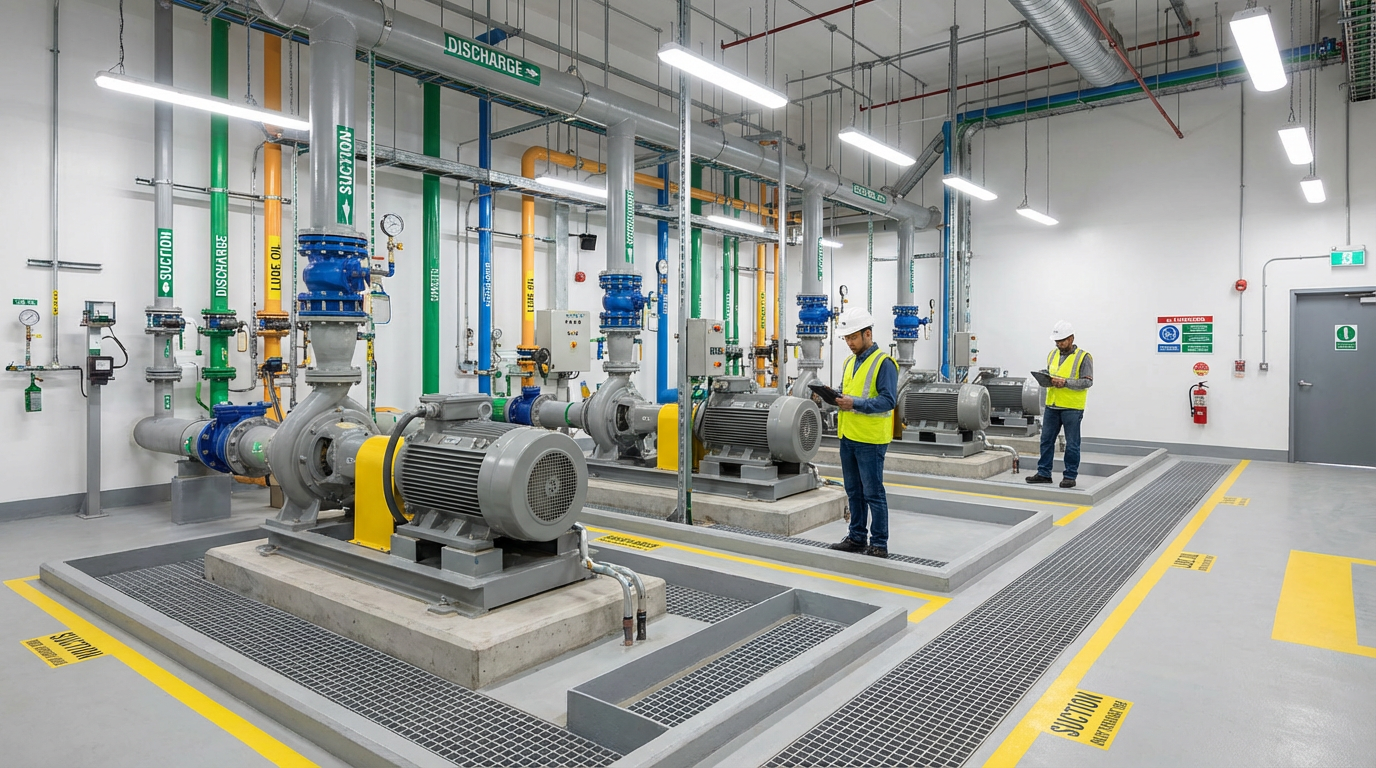
A clean pump room is helpful. A legible one is better. Good system design includes clear labels, consistent line identification, flow-direction arrows, and chemical names where people need them. The point is visual tidiness as well as faster, safer decisions. If a new operator cannot identify the suction line, the relief return, and the active discharge path in under a minute, the system is harder to run than it needs to be.
This also matters during troubleshooting. In poorly labelled systems, teams waste time proving what should already be obvious. In well-labelled systems, they move straight to the real issue.
Safe Sampling and Startup Points Make Better Operations Possible
A well-designed pump room makes normal work easy and unusual work manageable. That includes safe sample points, practical startup access, proper placement for calibration columns, and enough room around injection assemblies or strainers to inspect and service them without making a mess. If teams can verify flow, flush a line, or check a sample safely, they are much more likely to do it consistently.
When a pump room is designed well, people spend less time fighting the system and more time getting value from it. That is the kind of design that pays back for years.
We at Vissers Sales Corp specialize in optimizing pump systems to ensure maximum reliability and minimum operating cost. Reach out to us in Canada toll-free on 1-800-367-4180 to get a conversation started.