How to Calculate the Right Water Pressure Booster Pump Size for Industrial Facilities
Low or unstable water pressure can disrupt production, affect cooling processes, and increase equipment wear. Industrial facilities rely on consistent pressure to maintain process reliability and protect downstream components.
Oversizing a water pressure booster pump wastes energy, while undersizing creates flow limitations and pressure drops. Correct sizing ensures stable operation. It supports predictable performance and controlled operating costs.
Proper calculation is not guesswork. It follows clear engineering steps that align flow demand, total dynamic head, suction conditions, and system configuration.
Why Proper Booster Pump Sizing Matters in Industrial Facilities
Stable pressure is essential to prevent downtime and energy waste in industrial systems.
Industrial booster pump systems support:
- Process water circulation
- Cooling towers and heat exchangers
- Washdown systems
- Multi-floor distribution networks
- Equipment requiring a regulated inlet pressure
Incorrect sizing often results in:
- Excessive cycling
- Cavitation
- Seal and bearing damage
- Higher electrical consumption
- Inconsistent system pressure
A properly sized industrial pump system maintains pressure within required limits while operating near its best efficiency point.
Step 1: Determine Required Flow Rate (GPM)
Flow rate defines how much water the booster system must deliver. This is typically measured in gallons per minute (GPM).
To calculate the required flow:
- Identify all connected equipment.
- Determine peak demand for each fixture or process.
- Account for simultaneous operation.
- Include a safety margin without overestimating.
Industrial facilities may reference
- Process equipment specifications
- Cooling system demand
- Fire protection integration (if applicable)
- Production expansion forecasts
Flow rate forms the foundation of pump sizing. All subsequent calculations depend on this number.
Step 2: Calculate Total Dynamic Head (TDH)
Total dynamic head (TDH) represents the total resistance the pump must overcome. It includes more than vertical lift.
TDH consists of:
- Static head (vertical elevation difference)
- Friction loss in piping
- Losses from valves, fittings, and elbows
- Required discharge pressure at the point of use
TDH formula (simplified):
TDH = static head + friction losses + required discharge pressure
Static head is straightforward. Measure the vertical distance between the water source and the highest discharge point.
Friction loss requires:
- Pipe length
- Pipe diameter
- Flow rate
- Fitting count
Engineering charts or friction loss calculators provide accurate estimates. Ignoring friction loss is one of the most common sizing errors. Long piping runs or undersized pipe diameter significantly increase TDH.
Step 3: Evaluate Suction Conditions & Inlet Pressure
Suction conditions determine whether the water pressure booster pump can operate safely.
Important factors include:
- Available inlet pressure
- Net positive suction head available (NPSHa)
- Fluid temperature
- Supply tank elevation
If the inlet pressure is too low, the pump may experience cavitation. Cavitation causes vibration, noise, and premature impeller damage.
Booster systems connected to municipal supply lines require:
- Minimum incoming pressure measurement
- Peak demand pressure verification
Booster systems connected to storage tanks require:
- Stable suction piping design
- Proper pipe diameter
- Adequate submergence
Evaluating suction conditions protects pump longevity and ensures smooth pressure regulation.
Step 4: Choose the Right Pump Configuration
Once flow and TDH are known, the next step is selecting the pump configuration. Common booster system configurations include:
Single pump systems
- Suitable for consistent, predictable demand
- Lower upfront cost
- Limited redundancy
Duplex (two-pump) systems
- Alternating operation reduces wear
- Provides redundancy
- Handles variable demand more efficiently
Triplex or multi-pump systems
- Ideal for large facilities
- Adjust output in stages
- Improve energy efficiency under fluctuating load
Control methods also influence performance:
- Pressure switches
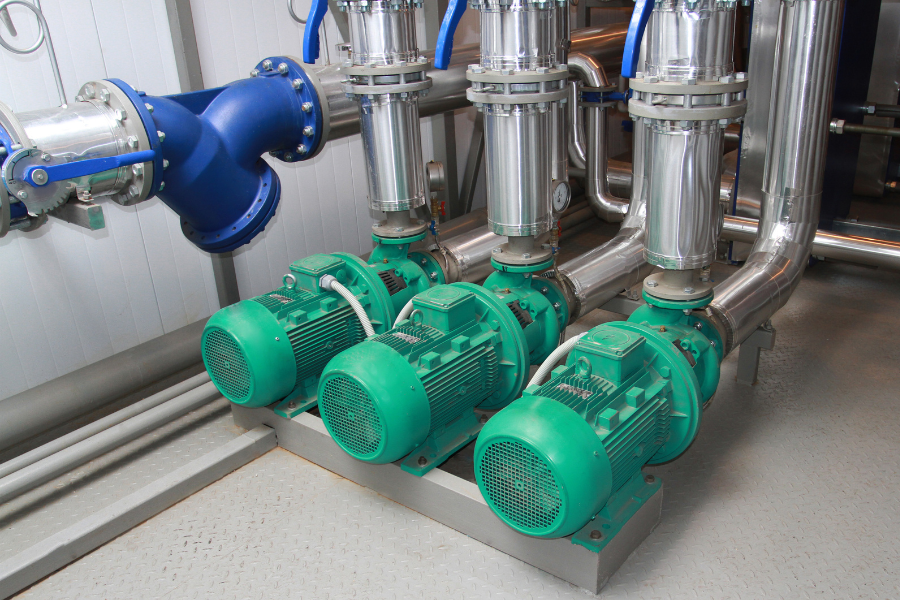
- Variable frequency drives (VFDs)
- Pressure transducers
Variable frequency drives allow pumps to adjust speed based on demand, further reducing energy consumption and limiting pressure spikes. Proper configuration ensures that the booster pump operates within an optimal performance range rather than constantly cycling at full capacity.
Common Sizing Errors in Industrial Booster Systems
Even well-maintained facilities encounter sizing challenges. Frequent errors include:
- Overestimating flow requirements
- Ignoring friction loss in long pipe runs
- Failing to measure the minimum inlet pressure
- Selecting pumps far from the best efficiency point
- Neglecting system expansion plans
Oversized pumps often short cycle. This increases motor wear and wastes electricity. Undersized pumps struggle to maintain pressure. This creates inconsistent flow and operational disruption. Accurate sizing reduces both risks.
Why System-Level Evaluation Matters
An industrial pressure booster pump does not operate alone, but as a part of a broader system. Evaluating the entire system ensures balanced performance.
System-level considerations include:
- Pipe sizing and layout
- Control panel integration
- Tank capacity
- Backflow prevention devices
- Downstream pressure requirements
The hydraulic balance between supply and demand determines overall efficiency.
Industrial facilities benefit from reviewing:
- Historical pressure logs
- Energy consumption data
- Maintenance records
Data-driven analysis improves sizing accuracy and long-term reliability.
Also Read:
The Hidden Money Leak in Your Pump Room
Understanding the Risks of Oversized Water Pressure Booster Pumps
How to Improve Efficiency in Large-Scale Operations With Industrial Water Pressure Booster Pumps
Accurate Sizing Protects Performance and Operating Costs
Correct water pressure booster pump sizing achieves:
- Stable discharge pressure
- Reduced energy consumption
- Extended equipment lifespan
- Lower maintenance frequency
- Improved process consistency
Industrial facilities depend on predictable hydraulic performance. Careful calculation of flow rate, total dynamic head, suction conditions, and configuration ensures reliable performance. Booster systems then support operational goals instead of creating bottlenecks.
For facilities evaluating industrial pump systems, reviewing system requirements before installation prevents costly corrections later. Contact Vissers Sales Corp. to learn more about engineered water pressure booster pumps in Canada.