
An Engineer’s Guide to Capabilities and Constraints of Rotary Gear Pump and Sliding Vane
Rotary positive displacement pumps support many industrial processes that depend on measured, repeatable flow. Rotary gear pumps and sliding vane pumps sit at the centre of this category. Each design handles viscous fluids well, supports steady discharge, and provides strong volumetric control. Yet their internal mechanisms differ in ways that shape performance, energy use, and maintenance behaviour.
This guide outlines the capabilities and limitations of rotary gear pumps and sliding vane pumps. This will help engineers match pump design to process demands with confidence.
How Rotary Gear Pumps Work
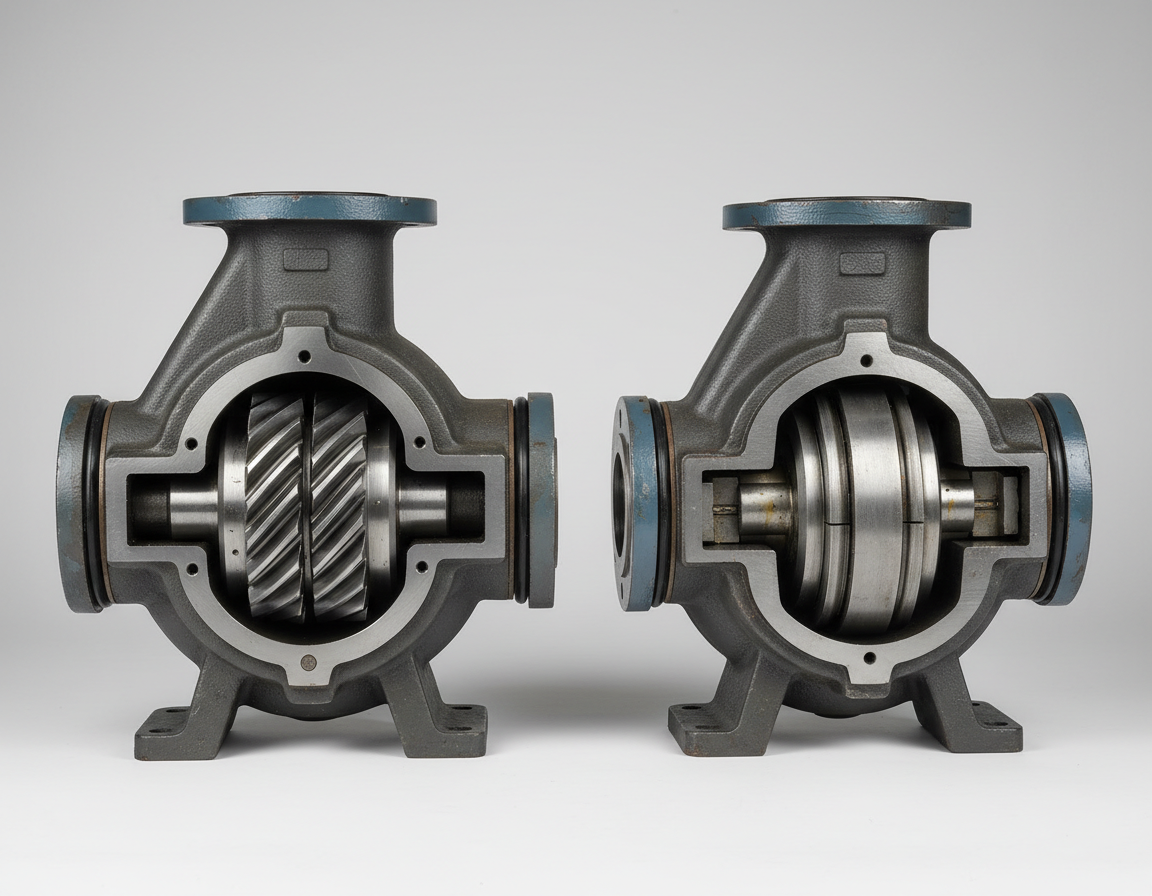
Rotary gear pumps use two meshing gears inside a close-tolerance housing. As the gears rotate, fluid fills the cavities between the gear teeth and the casing. The fluid then moves around the perimeter of the chamber until discharge pressure forces it out of the pump.
Key performance characteristics
- Steady, pulseless flow
- Strong suction lift
- Reliable operation with viscous fluids
- Tight tolerances that support precision metering
- Minimal internal slippage at moderate pressures
The straightforward mechanical design keeps flow behaviour predictable across a wide range of industrial applications.
Where This Pump Design Performs Well
Rotary gear pumps perform well when handling lubricating and semi-viscous fluids, including oils, polymers, resins, adhesives, and fuels. Their rigid design and defined gear mesh allow the pump to maintain efficiency under continuous, steady-state operation.
Notable advantages
- High discharge pressure capability
- Consistent volumetric output
- Compact footprint for skid or system integration
- Broad temperature handling range
- Low pulsation for processes needing smooth flow
These strengths align well with chemical processing, lubrication systems, and metered transfer applications where stable performance matters.
Constraints of Rotary Gear Pumps
Despite their durability, rotary gear pumps have operating boundaries.
Primary constraints
- Gear wear increases internal leakage over time
- Solid particles cause rapid abrasion
- Low-viscosity fluids reduce efficiency
- Thermal expansion affects tight gear clearances
- Running dry causes immediate damage
Most limitations stem from the pump’s rigid tolerances, regardless of the gear pump supplier. When solids or thin liquids disrupt these clearances, performance drops quickly.
How Sliding Vane Pumps Work
Sliding vane pumps contain a rotor with radial slots. Vanes slide outward using centrifugal force and maintain contact with the casing. This creates expanding and contracting chambers that draw fluid in and push it toward discharge.
Key performance characteristics
- Self-compensating vane design
- High suction capability
- Good handling of thin liquids compared to gear pumps
- Consistent flow despite wear
Because vanes adjust automatically, internal clearances stay optimal even as components age.
Where Sliding Vane Pumps Excel
Sliding vane pumps handle a wide range of viscosities without losing efficiency. Their design helps maintain flow when pressure conditions shift or when the product composition varies.
Notable advantages
- Strong performance with low-viscosity fluids
- Superior self-priming
- Ability to handle light solids in suspension
- Low shear pumping is suitable for sensitive liquids
- Smooth, pulse-minimized discharge
Their adaptability makes them useful for fuel transfer, chemical distribution, and industrial fluid-handling systems that require flexibility.
Constraints of Sliding Vane Pumps
Sliding vane pumps offer strong performance, but their moving vanes introduce certain limitations.
Primary constraints
- Vanes wear faster in abrasive services
- Incorrect vane material selection reduces service life
- Casing wear increases if a dry run occurs
- Higher maintenance frequency than gear pumps in some duties
The pump performs best when the vane materials match the fluid’s chemical, temperature, and viscosity requirements.
Rotary Gear vs. Sliding Vane
Both pump styles support precise transfer, but their strengths suit different engineering needs.
Rotary gear pumps fit applications that require:
- High pressure
- Viscous, lubricating fluids
- Tight metering accuracy
- Minimal pulsation
Sliding vane pumps fit applications that require:
- Strong suction
- Low-viscosity fluid handling
- Flow stability under changing conditions
- Self-adjusting wear compensation
The decision often revolves around viscosity, suction needs, solids content, and acceptable maintenance patterns.
Also Read:
5 Warning Signs Your Industrial Pump System Needs Replacement
Pump Material Matters – Choosing the Right Alloy for Plant Longevity
How Rotary Gear Pumps Support Precise Fluid Transfer in Industrial Processes
Making Confident Pump Decisions Through Clear Engineering Insight
Rotary gear pumps and sliding vane pumps each deliver reliable, controlled flow after matching to the right duty. Understanding how their internal mechanisms influence performance helps ensure long-term stability and process efficiency. A thorough evaluation with trusted gear pump distributors prevents wear, reduces downtime, and ensures consistent output across industrial operations.
For support with selecting positive displacement pumps suited to specific process requirements, contact Vissers Sales Corp. today.