4 Types of Industrial Water Flow Meters: A Complete Comparison Guide
What Is a Water Flow Meter?
A water flow meter is a metering device that measures the rate or volume of water moving through a pipe, typically expressed in units like liters per minute (LPM) or gallons per minute (GPM). Industrial water flow meters use different measurement principles — mechanical rotation, vortex shedding, ultrasonic signals, or magnetic induction — to convert water movement into a readable flow rate.
A water flow meter is a metering accessory that measures the flow rate of water through a pipe. There are many water flow meter technologies and metering accessories to choose from, depending on your application, budget, and commitment to scheduled maintenance! The main question to answer is what device to choose for your specific measurement application, whether it is an ultrasonic or magnetic flow meter, volumetric or mechanical, each one with specific benefits and costs.
Below, we break down the four most common water flow meter types, compare them side by side, and outline how to choose the right flowmeter for water based on your pipe size, water quality, and application requirements.
Mechanical water flow meters
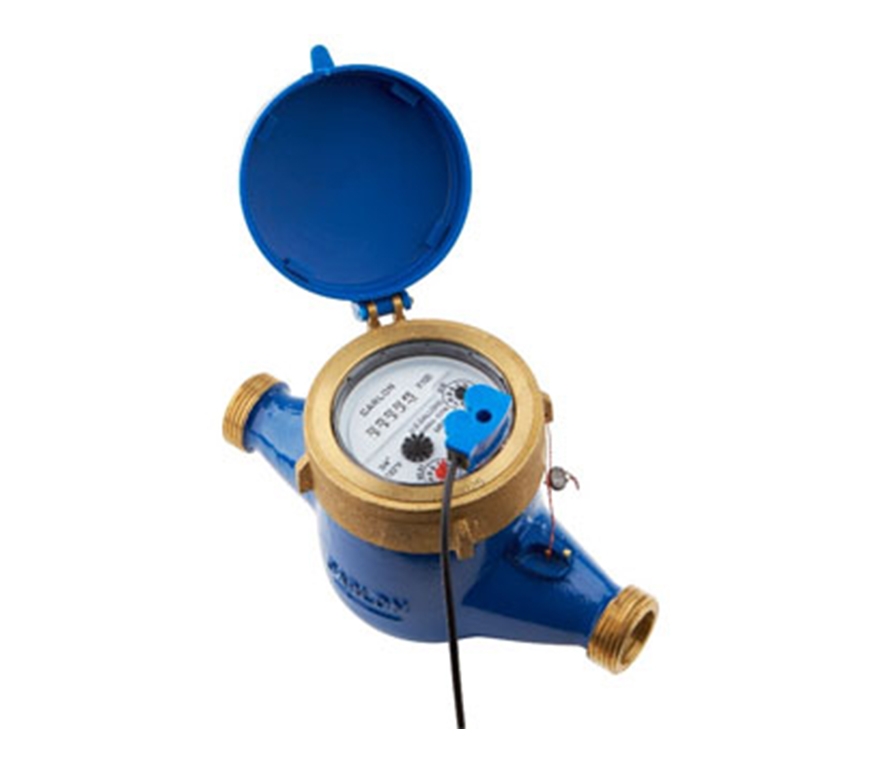
Mechanical flow meters are the most common of the industrial water flow meter range. They’re also the most budget friendly! A mechanical flow meter uses the rotation of a turbine to measure flow. The speed at which the blades spin is proportionate to the volumetric flow rate of the water.
This means they don’t work with low water pressure systems. While accurate, mechanical flow meters can clog up when the water contains larger particles or is unclean, which can lead to higher maintenance costs.
Typical accuracy: ±2% to ±5% of reading, depending on turbine condition and water cleanliness. Mechanical flow meters remain a strong choice for straightforward, budget-conscious applications with relatively clean water and stable pressure.
Vortex water flow meters
Vortex water flow meters work differently to mechanical flow meters by measuring flow using the vortices or swirls that are produced when the water moves past a blockage. In a vortex meter, the frequency of the vortices is proportionate to the velocity of the flow. Vortex water flow meters can be multivariable, measuring up to five variables such as temperature, density, volumetric flow, pressure, or mass with just one connection.
Typical accuracy: ±1% of reading, making vortex meters a good middle-ground option between mechanical and higher-end ultrasonic or magnetic technologies.
Ultrasonic water flow meters
Just like the name suggests, ultrasonic water flow meters use ultrasound to measure water’s flow rate. The difference in the receiver times of two ultrasonic signals transmitted in opposite directions, upstream and downstream, is equal to the flow rate.
Suitable for high flow rates and non-conductive water, ultrasonic water flow meters can clamp on to the pipe from the outside, allowing them to measure water flow in large pipes.
Typical accuracy: ±1% to ±2% of reading. Because clamp-on ultrasonic meters don’t require pipe penetration, they’re often the preferred choice for retrofitting flow measurement onto existing infrastructure without shutting down the system.
Magnetic water flow meters
Magnetic flow meters are another type of industrial water flow meter that measure the flow rate of water using a magnetic field. This works on the principle that any liquid will generate voltage when flowing through a magnetic field. The faster the flow, the more voltage generated – directly proportional to the movement of water. Highly accurate, and usually with visible LED displays, magnetic flow meters are suited for most applications except custody transfer or to measure pure water.
Typical accuracy: ±0.5% of reading, making magnetic flow meters one of the most accurate options available for conductive water applications — though this precision comes at a higher upfront cost than mechanical or vortex meters.
Water Flow Meter Types Compared
| Feature | Mechanical | Vortex | Ultrasonic | Magnetic |
|---|---|---|---|---|
| Typical accuracy | ±2–5% | ±1% | ±1–2% | ±0.5% |
| Relative cost | Lowest | Moderate | Moderate-High | Highest |
| Maintenance level | Higher (moving parts) | Low | Very Low | Very Low |
| Works with dirty/particulate water | Poor | Moderate | Good | Good |
| Works with non-conductive water | Yes | Yes | Yes | Yes |
| Installation type | Inline | Inline | Inline or clamp-on | Inline |
| Best for | Budget-conscious, clean water applications | Multivariable process monitoring | Large pipes, retrofits, non-conductive fluids | High-accuracy, conductive water, drinking water supply |
This comparison makes it easier to match a flowmeter for water to your specific combination of budget, water quality, and accuracy requirements before making a purchasing decision.
How to Choose the Right Water Flow Meter
Selecting among these water flow meter types comes down to a few key application factors:
Water quality: Clean water suits mechanical meters; water with particulates favors ultrasonic or vortex designs.
Water conductivity: Magnetic flow meters require conductive water and won’t work for pure or deionized water.
Pipe size and access: Clamp-on ultrasonic meters are ideal when you can’t shut down the line or cut into large-diameter pipe.
Accuracy requirements: Magnetic and vortex meters offer the tightest accuracy for regulatory or billing-grade measurement.
Budget and maintenance capacity: Mechanical meters cost less upfront but typically require more frequent maintenance due to moving parts.
Ultimately the type of flow meter to choose will depend on the applications. Most water management and industrial installations use magnetic or ultrasonic flow meters to measure water consumption. These devices are also well suited for drinking water supply – and can come with programmed switches and alarms.
To find out the right type of industrial water flow meter for your facility, give us a call on 1-800-367-4180 (toll-free). We are your industrial pumps supplier in Canada and we’re here to help you choose, install, maintain, and monitor a variety of equipment. And to answer questions about things you’ve previously tried gone wrong.
For related guidance on keeping your flow measurement equipment running reliably, see our post on how to catch pump issues before they become emergencies.